Driving / Technique
Background
Driving a race car as fast as possible is all about the corners (anyone can go fast on a straight!). Driving a corner as fast as possible is (mostly) about using every bit of tire grip available. The proper method of doing so was established decades ago when racers began to notice that combining longitudinal (accelerating, braking) and lateral (cornering) forces was the optimal approach.
Originally, longitudinal and lateral forces were not combined. All braking was done before turn-in, at which point the driver would jump off the brakes and quickly turn the wheel as much as needed to make the corner. Then, once the driver was facing out of the corner, they would quickly straighten the steering wheel and get on the power as hard as possible.
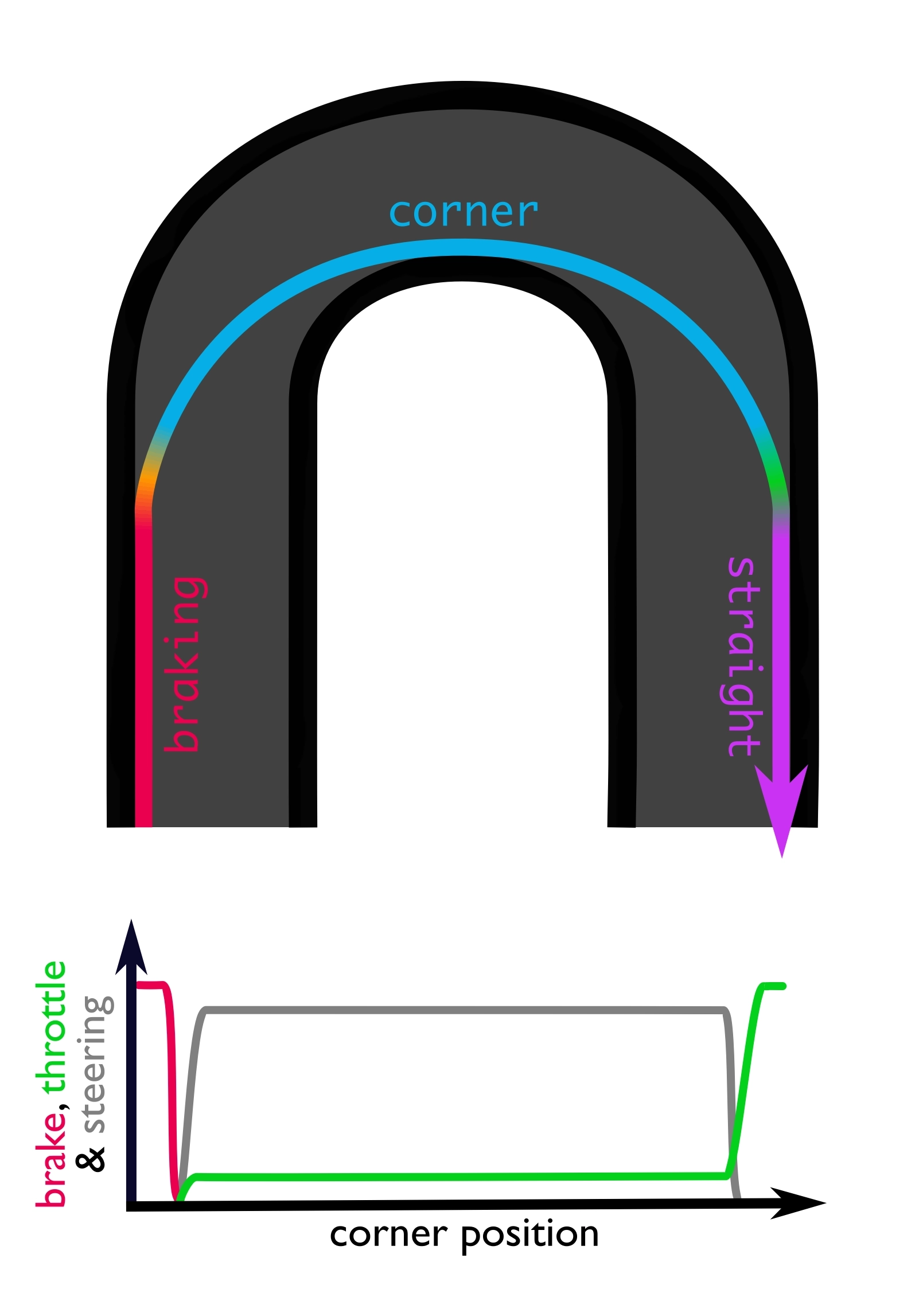
Maximum braking, followed by maximum cornering, followed by maximum acceleration; sounds perfect! But this approach actually leaves a lot of grip unused, specifically during the transition phases.
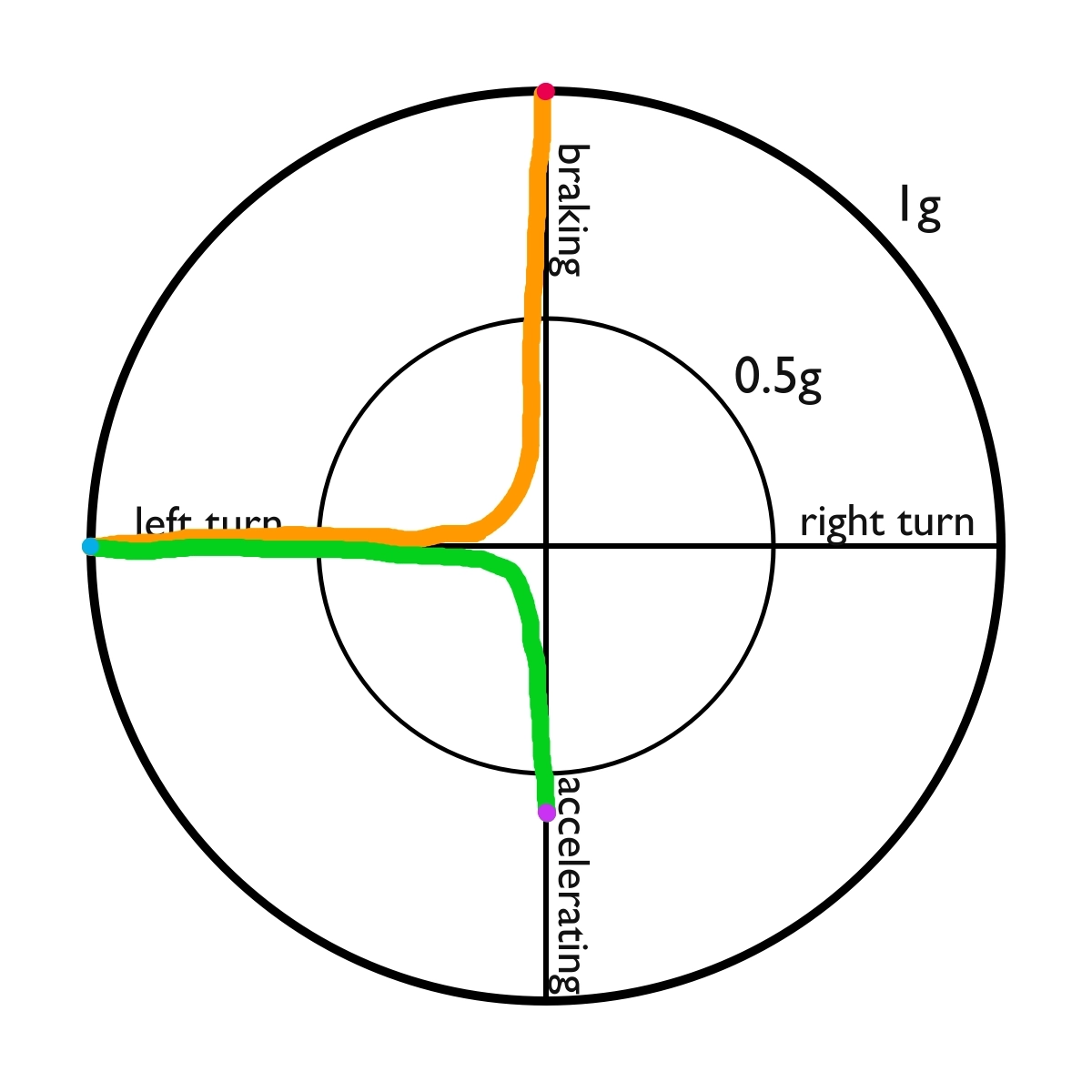
Cornering has two transition phases—each of which take a not insignificant amount of time to complete—where the car is moving from one posture to the next. With this cornering technique, the car is not using all available grip during these transition phases.
Decades ago, drivers innovated on the standard cornering technique by realizing that combining longitudinal and lateral forces during these transitions was faster. This was later verified theoretically by dynamicists.
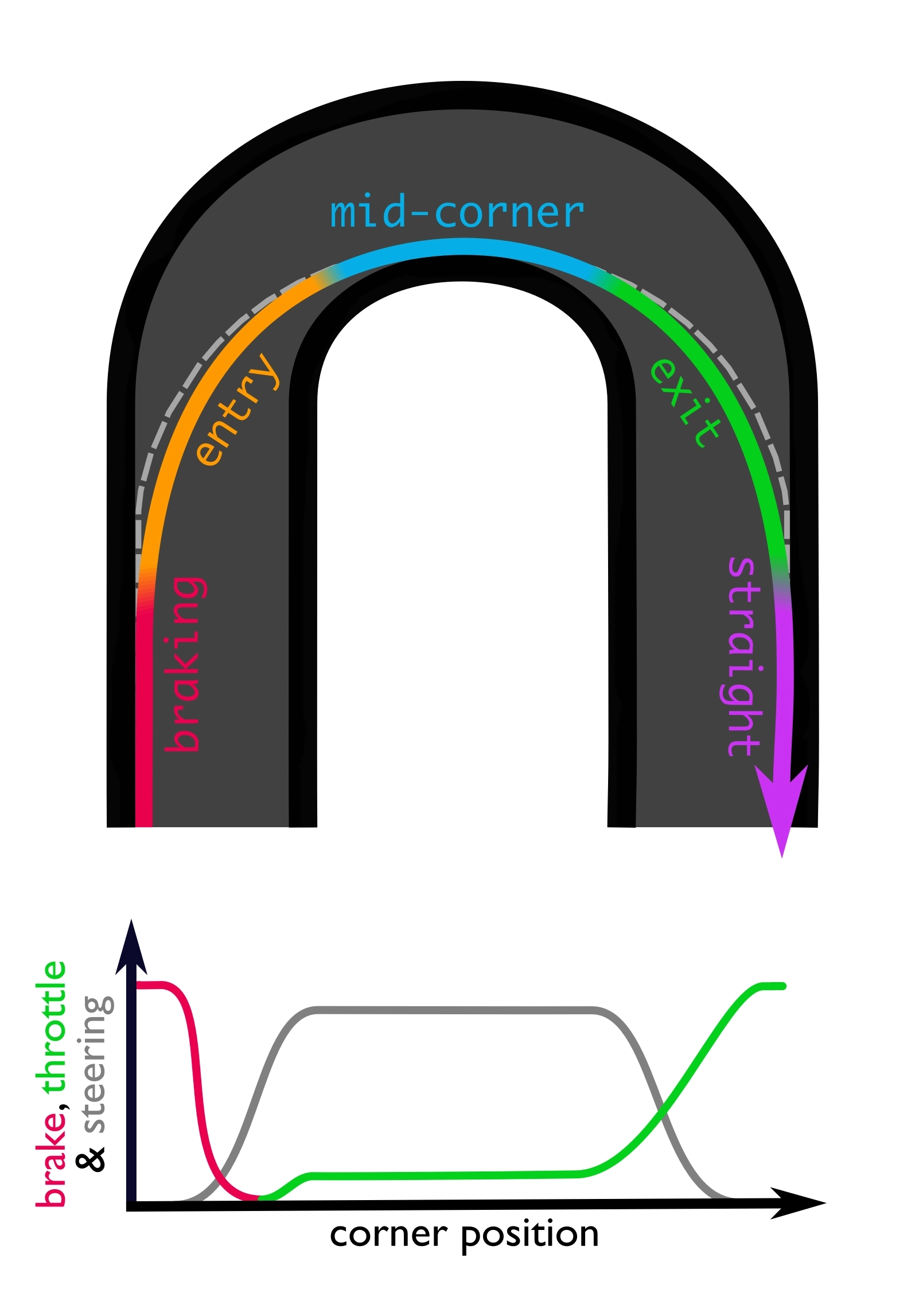
These drivers noticed they could ease out of one phase while easing into the next, allowing them to overlap. There will still be two transition phases, but the driver will slowly blend between phases instead of dropping one to pick up the other. If done skillfully, the driver can avoid any time where the car is not on the limit of grip.
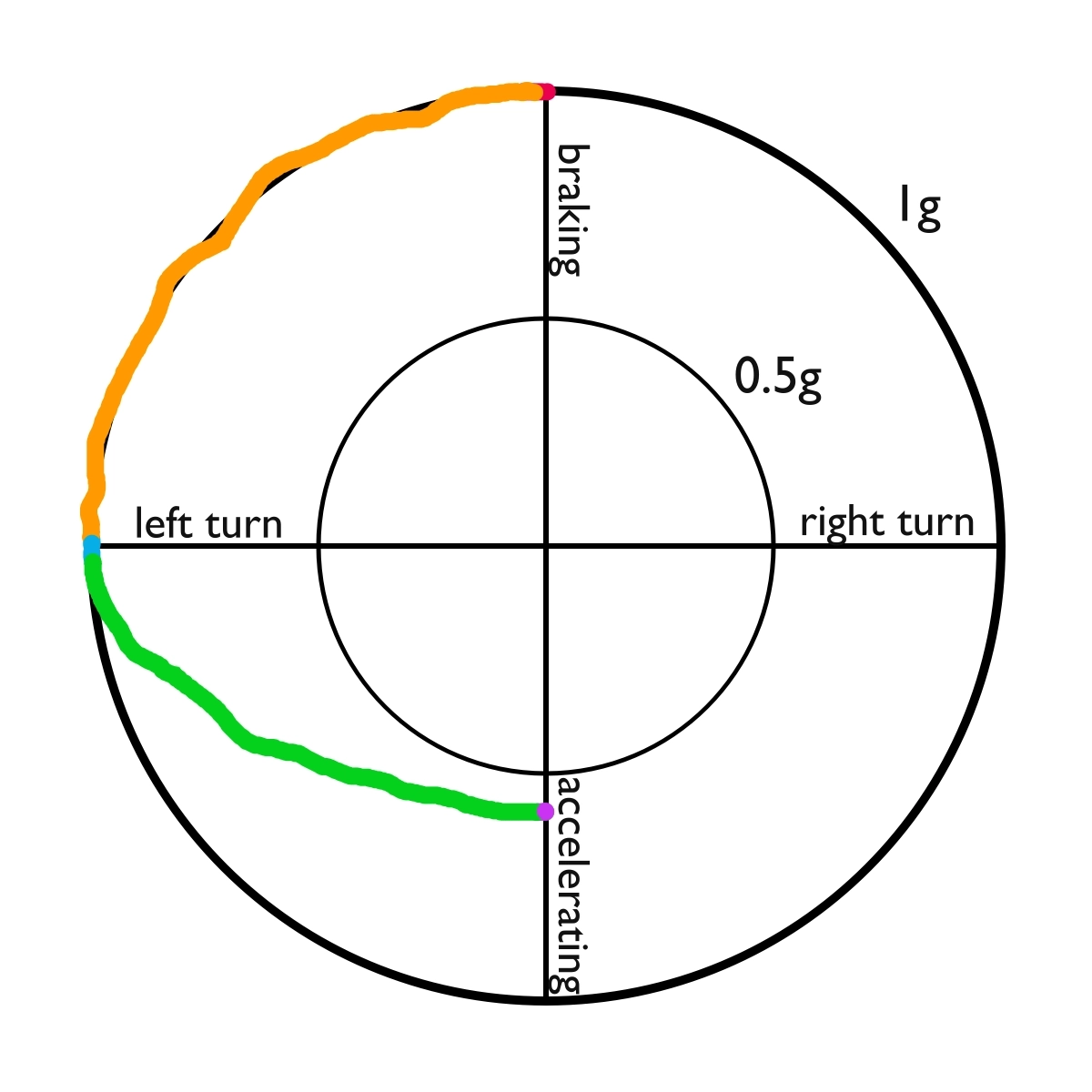
To be specific, during the corner entry transition, instead of jumping off the brakes and cranking on the steering, a driver will ease off the brakes while easing in the steering. Likewise, during the corner exit transition, instead of quickly straightening the steering and flooring the throttle, a driver will ease out the steering while easing onto the throttle.
With transitions like these, the tires will always be using max available grip. Furthermore, the resulting racing line will be a gradually tightening spiral into the corner (because the vehicle continues to slow and the steering continues to grow), and a gradually increasing spiral out of the corner (as the vehicle builds acceleration and the steering angle shrinks). The removal of gaps in the transition phases and the tighter, spiraling line are what together make for a faster cornering technique.
This of course means that during the transition phases, the driver must balance on the limit of grip via multiple inputs simultaneously (the steering wheel and a pedal).
This modern technique is more delicate and complex, but rewards the driver with faster cornering and is the fundamental method of driving quickly to this day.
General Approach
The braking point is the start of the corner and sets up the rest of the cornering phases. However, while having a defined braking point is important, the first and most important reference point is where to turn-in.
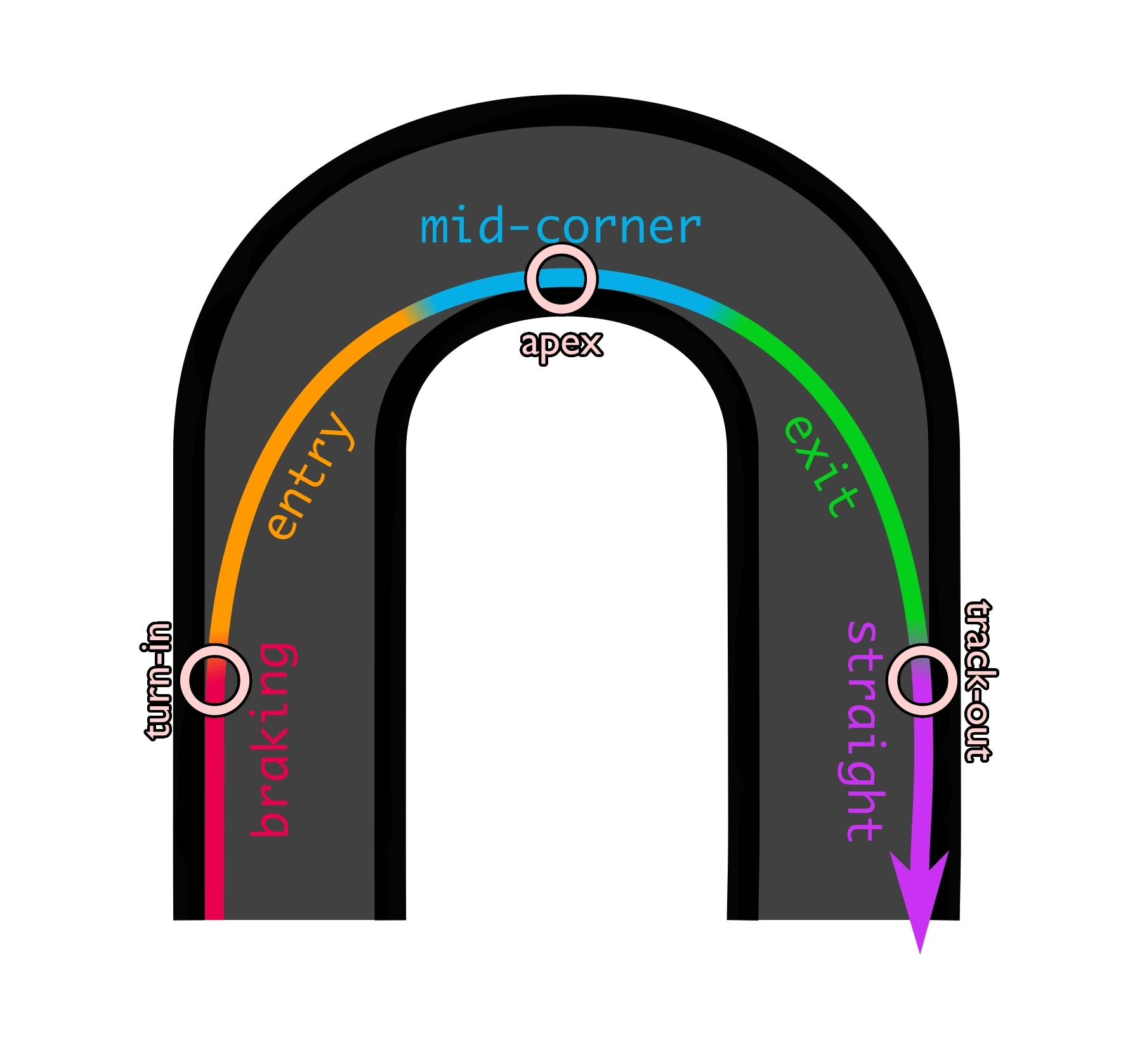
The turn-in point is not only the location where you begin corner entry, but it also defines the speed you intend to carry into the corner as well as the entry posture of the vehicle.
Note
The “posture” is how much nose dive the vehicle has due to braking. Typically it will be heavily nosed down due to threshold braking, but if the vehicle has aerodynamic elements, some high-speed corners are better driven with the vehicle coming in flatter—that is, not braking at threshold—to promote better balance.From here, the rest of the corner follows naturally given the vehicle’s cornering capabilities—and a driver that can keep it on the limit of grip throughout. The entry, apex, and exit characteristics all flow forward from the turn-in, and the length of the preceding braking zone flows backward.
In practice, a driver will have done their homework and will have a general understanding of the track and how they want to approach each corner before they ever get in the car. Then, a driver will get on track during a practice session and slowly build up their turn-in speed for each corner lap after lap, while simultaneously refining their turn-in point.
The final, refined turn-in is the anchor for the corner.
Cornering Phases
Braking
The braking phase is where a driver slows the vehicle down as much as necessary before reaching the turn-in point. Typically, the driver will apply as much braking force as possible before the wheels lock up—this is called “threshold braking”. If a vehicle has ABS, the driver can be less concerned with lock ups.
Entry
The entry phase is essentially bending the vehicle into the corner, easing off the brakes while easing in the steering (”trail-braking”). This phase ends when the steering has reached its maximum angle where we then enter the mid-corner phase.
Right before you arrive at turn-in, pick up your vision and look as far into the corner as possible, through the apex. If you can’t yet see the exit curbing due to walls, barriers, etc., use your imagination to visualize it. Your goal is to have a heads-up, mental embodiment of the corner you will be moving through as you begin turning the steering wheel. This includes turning your head toward the apex and pointing your vision through it.
Mid-corner
The mid-corner is where the vehicle maintains a constant speed and cuts an arc of constant radius through a corner. The driver is moving through the corner as quickly as possible while waiting for the exit to present itself so they can accelerate out.
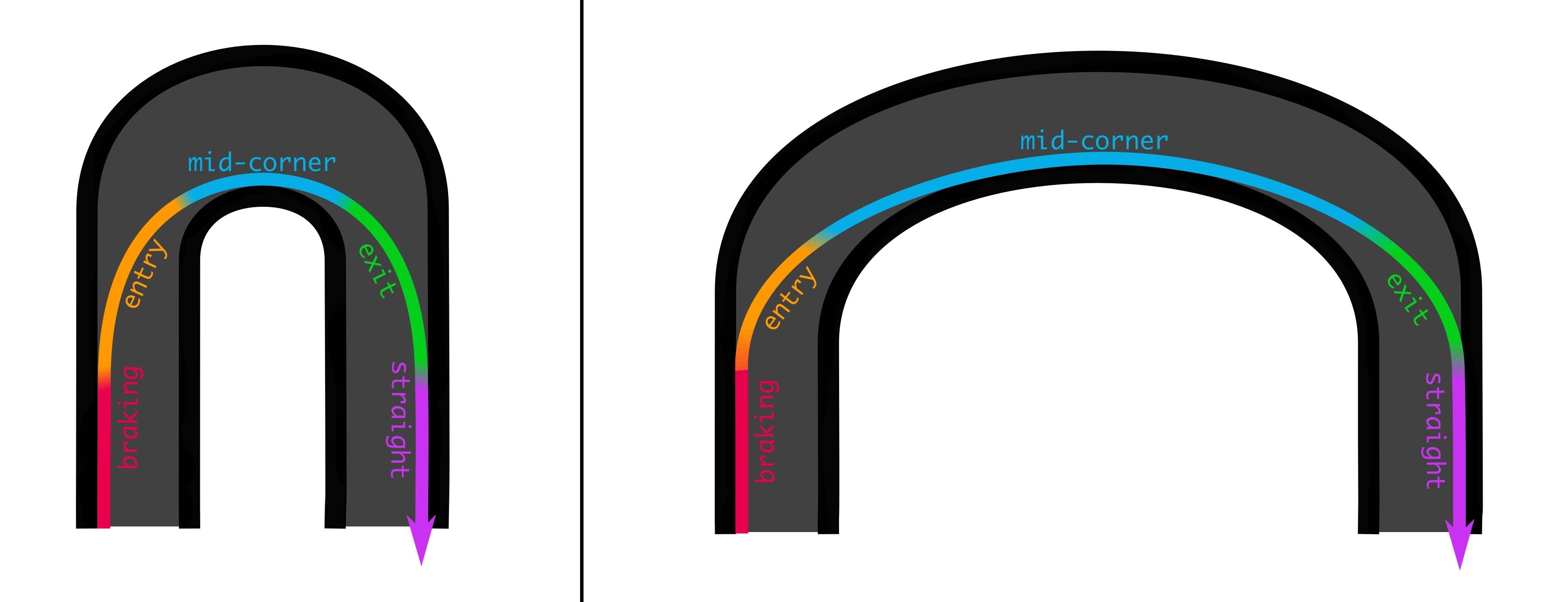
Short corners will have short, or non-existent mid-cornering phases. Long corners will have very long mid-corner phases as one waits for the opportunity to accelerate out of the corner.
The mid-corner phase requires a constant amount of “maintenance throttle”—like driving on a highway—to ensure the vehicle maintains a constant speed against the friction forces of the road, air, drivetrain, etc.
The transition off the brakes and onto maintenance throttle should not be felt, perhaps even overlapping one another a small amount during the transition (if left foot braking). Releasing brake pressure should feel like gently stepping off a bed mattress without disturbing the person sleeping. Coming onto the throttle should be a squeeze, even if done quickly; never kick the throttle pedal.
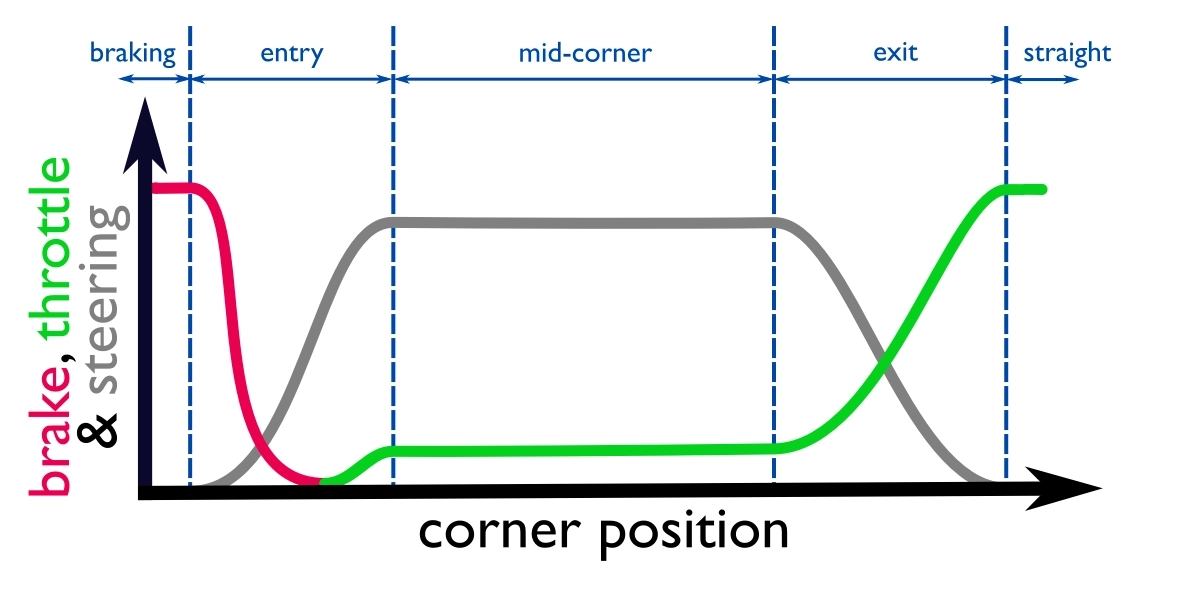
Note that, due to engine braking, friction forces, etc., coming onto the throttle up to maintenance level is still a part of corner entry, that is, still slowing the car and tightening the turn. This short period of increasing throttle up to maintenance should coincide with the last bit of added steering lock at the very end of corner entry.
For beginner drivers, it is very easy to fall into the habit of ceasing to add steering input when brake pressure reaches 0% instead of continuing to add steering input until the throttle has come up to maintenance. This will make the end of corner entry feel unstable for rear engine vehicles because the engine braking will be costing grip on the rear wheels while you try to reach maximum lateral cornering. What’s more, coming onto throttle to prevent the car from slowing will be confusing, as the rear tires will first gain grip (as engine braking is reduced) and then lose it again (as you hunt for the maintenance throttle level and perhaps accidentally power oversteer). When learning the technique, make a conscious effort to come up to maintenance throttle during the last bit of added steering lock at the end of the entry phase; this will make the transition from the end of entry into mid-corner much smoother and more intuitive—and faster!
Real world
Don’t hold the turn through the mid-corner for longer than necessary. It feels fast to hold the maximum lateral g’s for as long as possible, but it’s slower if we end up rotating more than necessary and delay the exit (acceleration) phase. If the vehicle isn’t being pushed wide to the outer edge of the track on exit, it’s a sign that the exit phase was delayed.Exit
A critical skill a race car driver must have is the ability to distinguish between tire side-bite and forward-bite. Side-bite is the feeling of the tire providing lateral grip during cornering; forward-bite is the feeling of the tire providing longitudinal grip during acceleration. Feeling the transition from side-bite to forward-bite during the exit phase is key to fast exits.
If the car is sliding sideways more than clawing itself forward, you are on the throttle too aggressively (and perhaps the vehicle setup needs work). On the other hand, if the car launches forward very eagerly on exit with throttle application, perhaps you are waiting too long to get on throttle and could potentially begin accelerating sooner.
Like the entry phase, the exit phase requires a delicate trade between lateral and longitudinal grip. If it doesn’t feel as if you are gradually trading one for the other, you are not optimizing the combined lateral and longitudinal loading during this phase of the corner, leaving a flat spot on the g-g diagram.
Progression
When learning to drive on the limit, it will be slow and difficult to build every skill simultaneously. Instead, focus on one cornering phase at a time until you can comfortably drive it on the limit.
Each phase can take weeks or months, so don’t feel rushed. And even when you’ve gone through the progression once, you should immediately start over, improving each phase further.
The proper progression is exit phase, then entry phase, then mid-corner.
And once you reach an advanced level, this progression can be used when getting up to speed with a given car/track combination. Ensure proper exits first, then entries, and finally mid-corners.
Master corner exit speed
- Know/discover whether this corner is best taken with a early, standard, or late apex.
- Consistently hit the proper apex.
- Use all the road on exit; the car should gently understeer toward the track’s outer edge as you progressively increase throttle and unwind steering lock, ensuring an optimal transition out of the corner.
Master corner entry speed
- Refine turn-in location, speed, and posture in order to carry in as much speed as possible while still hitting the proper apex and getting a great exit.
- Perfect trail-braking to ensure you get the most out of the entry phase, always rotating as much as the vehicle will handle, and carrying in more speed if you find yourself apexing too early.
Master mid-corner speed
- Ensure you are staying perfectly on the limit when transitioning between brakes and throttle; there should never be a moment where you feel like you can turn more but choose not to.
- If such a moment exists when transitioning into the mid-corner, you likely slowed the vehicle too much.
- The shape and duration of the mid-corner are heavily tied to the racing line. Details are outside the scope of this article, but the best drivers have built an intuition for what line to take through any given corner and they know how to shape the mid-corner accordingly.
- Mastering the various line shapes through any given corner (and knowing which is best) is the final piece to becoming a fast driver.
Tips and Tricks
Don’t connect the dots
It’s good to have multiple, personal reference points for the racing line you want to follow, but as you build up familiarity and muscle memory, those exact points should smooth out and the entire corner should have a more intuitive feel. Do always start with reference points and use them, but don’t force them to stick around as your intuition begins to take over part way through a race weekend.
Connect the dots at first to ensure consistency when dialing in your braking, turn-in, apex, etc., but remember that the ultimate goal is to drive the car on the limit at all times, getting it through each corner as quickly as possible. Feeling for this directly—”Am I driving under/over the limit at this particular part of the corner? Do I need to adjust my cornering shape to make sure I can stay on the limit?”—and letting the cornering shape follow is the fastest and most athletic approach.
Connecting dots is a simplified conceptualization of the real thing meant to help drivers get up to speed; it’s not the complete picture of what’s happening.
Build and release your yaw
One way to get closer to the limit when cornering is to focus on keeping the car at it’s ideal yaw/slip angle at all times. As the vehicle turns, it should nose inward relative to the path you are traveling.
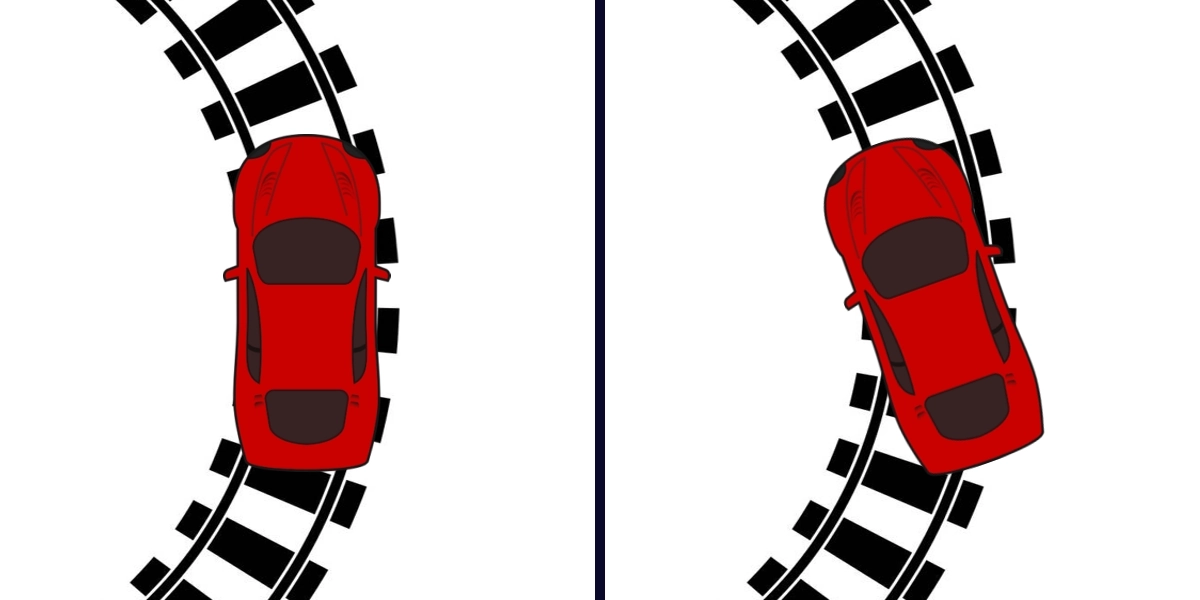
To better notice the yaw of your vehicle when cornering, pick up your head at turn-in and look ahead through the apex and beyond. It should feel like the car is slightly over-rotated and facing inward instead of forward throughout the entire corner (because it is!). Slip angle develops along with steering input; the amount of slip will be less during the entry and exit phases, and most during mid-corner phase.
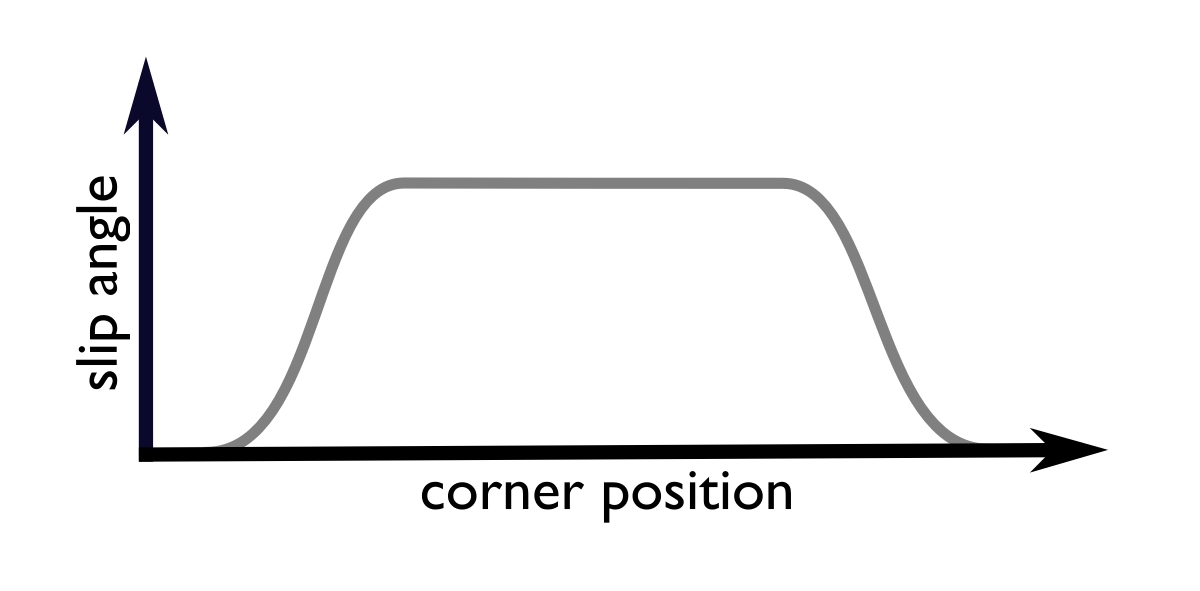
Don’t “throw/pitch” the car into corners (ie. aggressively turning the steering wheel and over-rotating) believing that getting the nose pointed in early is better at all costs. Over-yawing causes tire scrub, reducing speed and degrading the tires. We want to develop the yaw smoothly from none to maximum throughout the entry phase as we transition into the mid-corner phase, not all at once.
Sim racing
Sim racers have a tendency to stare at the patch of road right in front of them as they move through a corner. This is because without a seat-of-the-pants feel, yaw (slip) angles can only be determined visually, and new players typically do this by tracking the yaw of the ground in front of them.
Instead, learn to notice yaw angle by turning your head to face the apex as you approach turn-in, before cornering begins, keeping your vision high and wide, noticing how the vehicle yaws (slips) as you begin to turn the steering wheel.
In short, use the entire environment around you to notice yaw angle, not the patch of road in front of you. This head-up approach allows for improved spacial intuition as you move through the corner.
Ride the wave; lead the steering weight
It is important to remember that the more lateral grip the front tires produce, the heavier the steering feedback is for the driver. Therefore, as a driver maneuvers through a corner, increasing, maintaining, and then decreasing their steering input, it follows that they should be feeling a corresponding effect in the steering weight.
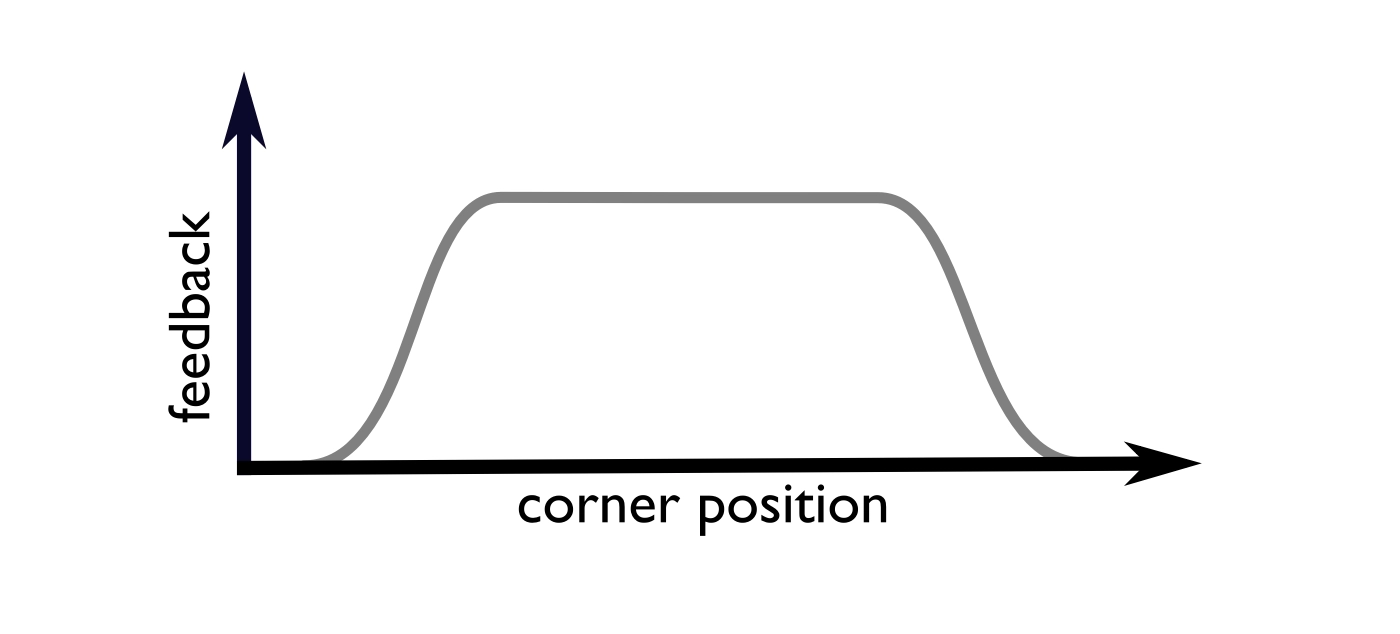
At the same time, it is also important to remember that the goal is to, at any given moment, be just ahead of the maximum steering weight the wheels can produce in order to be getting max performance out of our tires. This is because max lateral grip actually comes just after the point of max steering weight. Looking at the image below, we can think of it as “riding the wave”.
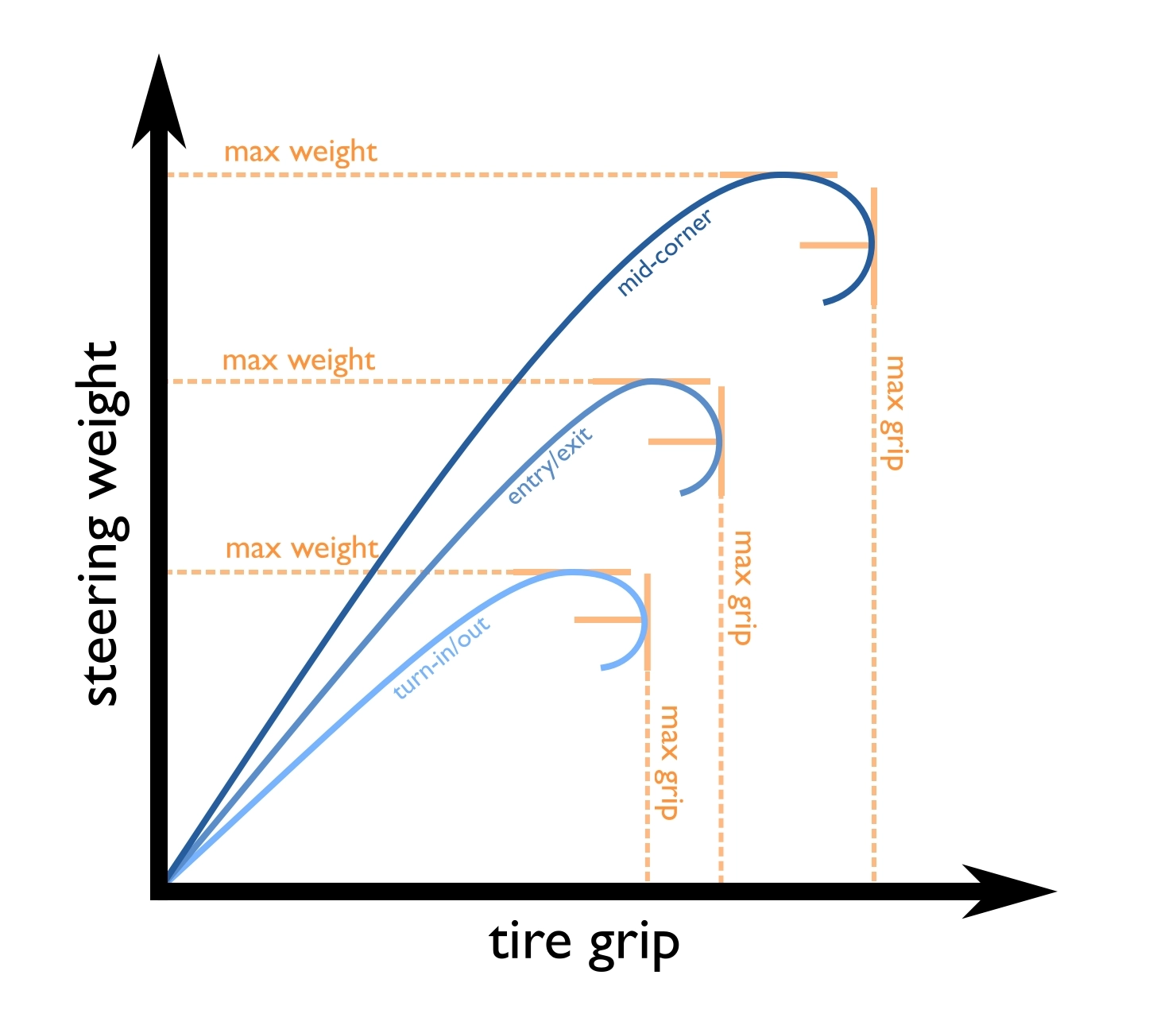
The goal is to always be just ahead of the hump, maintaining the vehicle on the limit. This goal is constant throughout a corner, even as the lateral grip (and thus, steering weight) comes and goes. The instantaneous “wave” of max grip builds slowly as we begin turning into the corner, reaches a maximum at the mid-corner, and then slowly retreats as we exit. It builds as we increase our steering input, stays steady as we maintain a steering input, and then retreats as we decrease our steering input.
Over-driving and under-driving both have a feel in the steering wheel. Over-driving always feels like a lightening of the steering weight, either due to the fronts losing grip during understeer slides, or from the back end coming around during oversteer moments. Under-driving usually feels heavier than driving on the limit as we will be sitting on top of the wave instead of riding just in front, afraid of the bleeding edge.
Feel for the limit, know how to balance
At some point during your racing career, you’ll stop looking at what you’re doing and begin to feel it. When this happens, noticing under-driving and over-driving, even for fractions of a second, will finally be obvious.
You’ll take a corner with a great looking line, but at some small point during the entry phase you’ll think to yourself, ”Hmm, it feels like I could rotate more if I wanted to… but I don’t want to because then I’ll apex too early, so let’s take it easy on the steering input for a second and not ruin my nice line.” This is an important milestone; your intuition knows you’re not at the limit. If you can rotate more during any fraction of the corner, but don’t, you’re under-driving. The remedy is to instead think “I have more ability to rotate than I’m using. If I was carrying a bit more speed into the corner, my inertia would carry me out wider and I would actually want to turn more, instead of taking it easy.”
Your goal is to always get as much rotation out of the car as you can while feeling like you’re just barely making the apex each and every time. You’re turning as much as you can at every fraction of the corner, never taking it easy in order to make the line work.
Remember, the goal is not to drive some theoretical racing line as accurately as possible, it is to keep the car on the limit the whole way through the corner; the actual handling tendencies of the car when being driven constantly on the limit will dictate the line it must follow in order to be on the limit. This is why different cars may take different lines on the same track.
Focus on always, always, always, keeping the car on the limit, rotating it as much as it can handle at all times. The shapes it makes when doing so dictates the line it takes through a corner. Your only goal, then, is to carry enough speed to touch the edges of the track on entry, apex, and exit, fitting the largest shapes possible without running off track.
Smooth hands, reactive feet
When cornering at the limit (as you should always be), you will use the pedals to turn the car. How so? The radius of the turn a car can take when driven at the limit is dictated by the speed of the car. The slower the car is moving, the tighter the radius, and vice versa. This means, to turn more, you need to trail-brake for longer, reducing the speed further, allowing for a tighter radius. And to turn less, you need to increase throttle, increasing the speed and forcing a wider radius.
The pedals dictate the speed, and therefore, the turning radius. The steering angle is whatever it needs to be to ensure you’re on the limit.
If you manage your trajectory with the steering wheel, then you are clearly driving under the limit. If you manage your trajectory with the pedals, only using the steering to “ride the wave” of the steering weight, then you are clearly driving on the limit.
Note that with a vehicle that understeers at the limit, trying to tighten the turn by turning the wheel too much will scrub off speed and therefore decrease the turning radius, sort of giving us what we want (a tighter turn). But it does this by scrubbing the front tires, increasing front tire wear and heat. The correct approach is to reduce speed via the pedals to allow for a tighter turn. This should also be a signal that vehicle setup is not well balanced.
As much as possible, don’t unload the steering wheel (ie. counter-steer) to manage a tendency for mid-corner oversteer; use the pedals instead! If you find yourself regularly oversteering mid-corner, you should get off the brakes and onto throttle sooner to induce a bit of understeer. In such a case, more throttle is good for balance, so why counter-steer when you can accelerate?
Let turn-in be the anchor
Remember, the turn-in is the anchor for the corner. The turn-in is comprised of the track location, vehicle speed, and vehicle posture.
If a corner isn’t coming together, refine your technique, starting by manipulating turn-in. Give yourself some margin under braking so that you have some room to experiment at turn-in (”Should I come in faster or slower? Should I turn-in earlier or later? Should I be threshold braking or braking lighter for the best entry posture?”). Then, once you’ve fixed the corner, tighten up the braking phase.
This is an ongoing process, lap after lap, as conditions change throughout a race. It should all be very subtle; a couple feet here and a few MPH there.