Driving / Technique
General
Shifts should not be felt! A felt shift is not only upsetting to the balance of a vehicle (which could cause handling problems if done while cornering), it is also harsh on the shifting mechanism which can wear over time. Ideally, shifts will be completed such that there are no noticeable jolts, ensuring the ride is smooth and the transmission will last the entire race.
Finish downshifts before turning in to a corner. Each downshift will inevitably upset car balance to some degree, so doing it under straight-line braking is the safest and most consistent approach. If possible, skip gears when downshifting. This could mean downshifting once, just before turn-in.
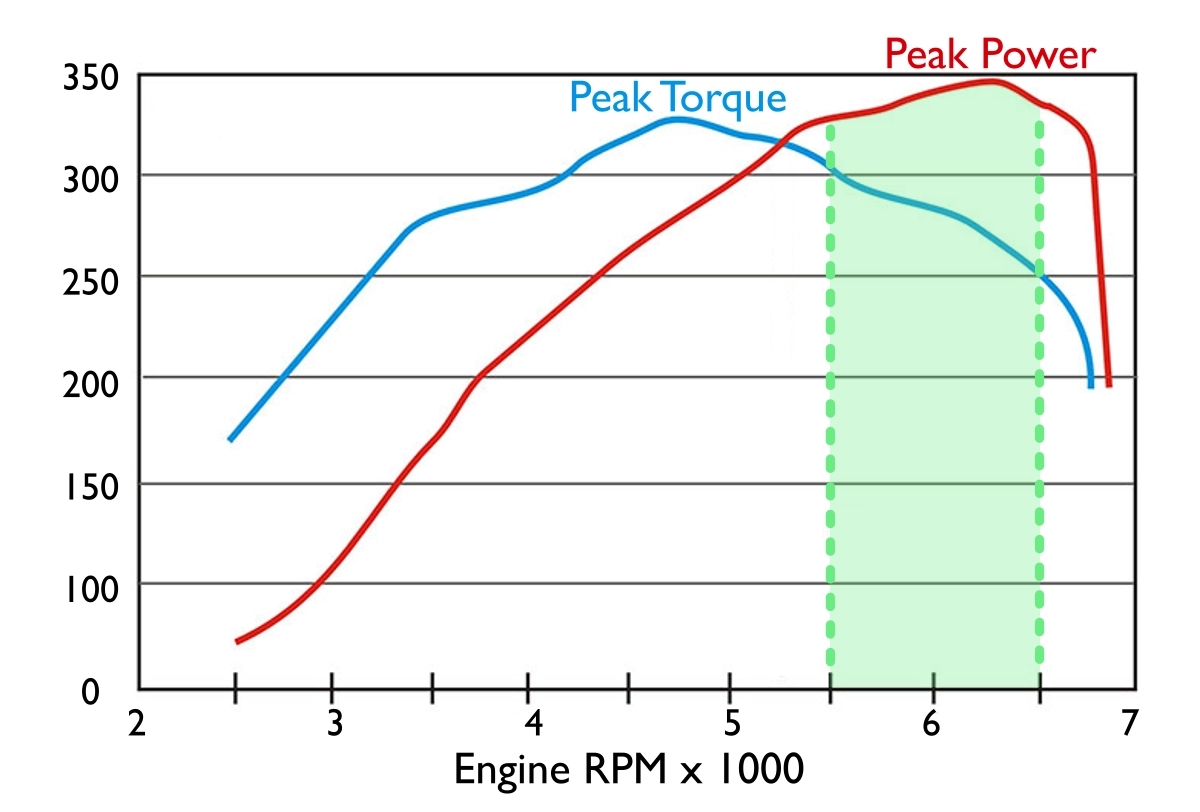
Upshift after peak power, but before power cliff. The goal when picking a shift point is to maximize the area under the BHP (”brake horse power”) curve. This typically means shifting at redline, but could be earlier if power falls quickly before that point.
Types of Shifts
Single clutch
Modern manual transmission road cars utilize a synchro-mesh device within the transmission to match the input shaft speed in the gearbox with the speed of the gear being selected. With this device, a single clutch shifting technique (lift off throttle, clutch in, move transmission out of old gear and into new gear, clutch out, squeeze on throttle) is appropriate.
This is the most typical way to shift any manual car, especially a road car.
Double clutch
For vehicles that do not utilize a synchro-mesh device, or for endurance vehicles with a dying synchro-mesh device, a double clutch shifting technique can be used (lift off throttle, clutch in, move transmission out of gear, clutch out, clutch in, move transmission into new gear, clutch out, squeeze on throttle). With this technique, the first clutch in/out cycle (with the transmission out of gear) allows the gearbox input shaft to sync up with the engine speed, doing the work of the modern synchro-mesh. The second clutch in/out cycle is for putting the transmission into gear.
It is rare for a vehicle to require double clutching in a racing context, except perhaps for manual transmission vehicles in an endurance event.
Clutchless (lift and shift)
Racing vehicles with manual road car transmissions will need to use either the single- or double-clutch shifting methods, depending on whether or not the transmission has a synchromesh. However, there are racing transmissions that are different from road car transmissions in that they have much stronger connections between their mechanisms and can be used without the smoothness of a synchromesh or a double-clutching technique.
Such robust transmissions are known as “dog box” transmissions, and these can be upshifted without a clutch. To upshift a dog box, simply lift off the throttle and move into the next higher gear. There will likely be some harshness to the shift, but it should pull into gear quite easily.
To downshift, the same lift-and-shift technique could be used, but because this could upset the vehicle too much as the driver brakes into a corner, it is usually still advisable to use a single clutch technique for shifting down.
As always, during an endurance event it may be worthwhile to shift a dog box with a clutch to prevent wear over the course of the race.
Clutchless (power shift)
Modern semi-automatic racing transmissions that are tightly coupled with the engine controller can automatically manage the throttle in order to allow the car to shift gears without the driver having to lift off the throttle or press the clutch.
In such a vehicle, simply trigger an upshift with the shift paddle or lever, and the engine controller with cut power for just long enough for the revs to drop as the new gear is engaged. From the driver’s point of view, just keep the throttle pinned and shift up.
To downshift, simply do the same; trigger a downshift with the shift paddle or lever and the engine controller will add power just long enough to increase the engine RPM to match the wheel speeds in the lower gear (so as to not upset the vehicle too much). The driver will be off the throttle when shifting down, but the engine revs will “blip” automatically to facilitate the gear change.
Clutchless (match and shift)
When racing a vehicle with a manual transmission, occasionally the clutch mechanism may wear and fail. When this happens, not all hope is lost. It is possible for such a gearbox to be shifted without the clutch if the driver has the right feel and a gentle touch.
To upshift a manual transmission without a clutch, the driver will have to first ease off the throttle so there is no torsion in the transmission (no power being transferred through the transmission), and then pull the transmission out of gear. Next, as the driver continues to come off the throttle completely, the engine revs will fall and eventually match the appropriate engine speed for the next higher gear, at which point the driver will gently push the gear lever into the next gear where it will slide in only when the wheel speed and engine speed are matched for that gear.
To downshift a manual transmission without a clutch, the driver must apply just enough throttle so there is no torsion in the transmission, and then pull the transmission out of gear. The driver must then add enough throttle to “blip” the engine revs up to the speed necessary for the lower gear so that the driver may then gently push the lever into gear as the revs rise up to the appropriate speed.