Driving / Getting Up to Speed
So, What is the Line Anyway?
When driving as quickly as possible around a racetrack, one does not simply drive the car wherever they please and hope to get good lap times. Every corner has an ideal shape the driver must take, and when driving on straights, the driver should be lining up the following corner.
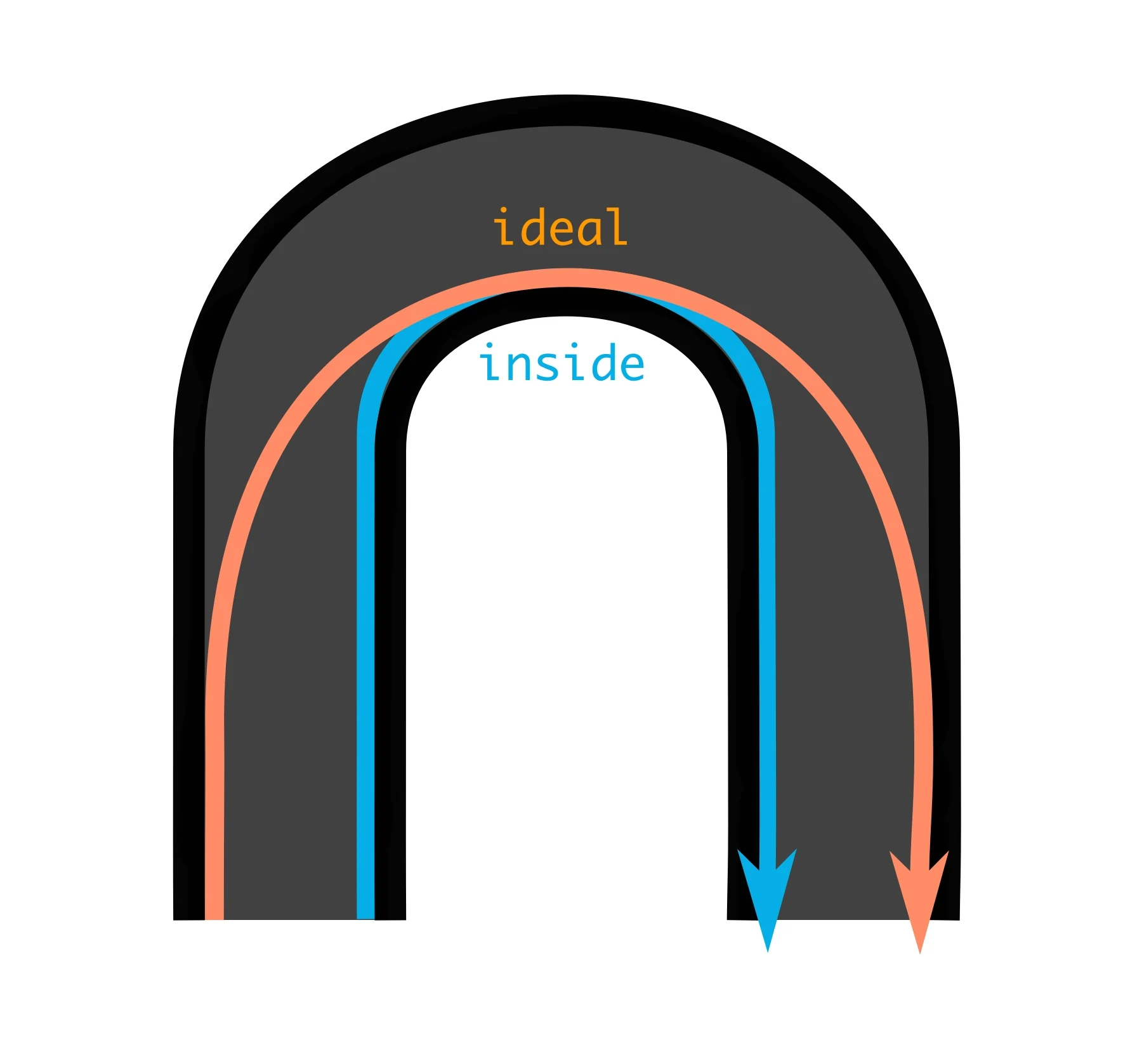
Generally speaking, the line is the longest path through a corner. This may sound counterintuitive as one might assume shortening the distance traveled through a corner would be the quickest way around, but this is in fact not the case.
Unlike a runner on a running track who can run their maximum speed while hugging the inside line, race cars are too fast for most corners and therefore must slow as they approach. The tighter the line driven through a corner, the more the car must slow. On the other hand, maximizing the distance traveled through the corner (that is, making the line through the corner as wide as possible) will maximize the speed the car can take. In the end, the longer way through will take less time.
The Big Picture
As discussed in the article on cornering technique, drivers—and later, dynamicists—discovered that the fastest way through a corner was to carry some braking into the first part of a corner and begin accelerating sometime during the last part of a corner.
This technique means that cornering is more than simply driving an arc of constant radius; instead, every corner exists as a series of phases.
The Line’s Phases
The line through a corner is not a constant arc but instead has three phases. When including the braking phase before the corner and straight acceleration phase after the corner, navigating a corner means moving through five phases; three static phases and two dynamic phases.
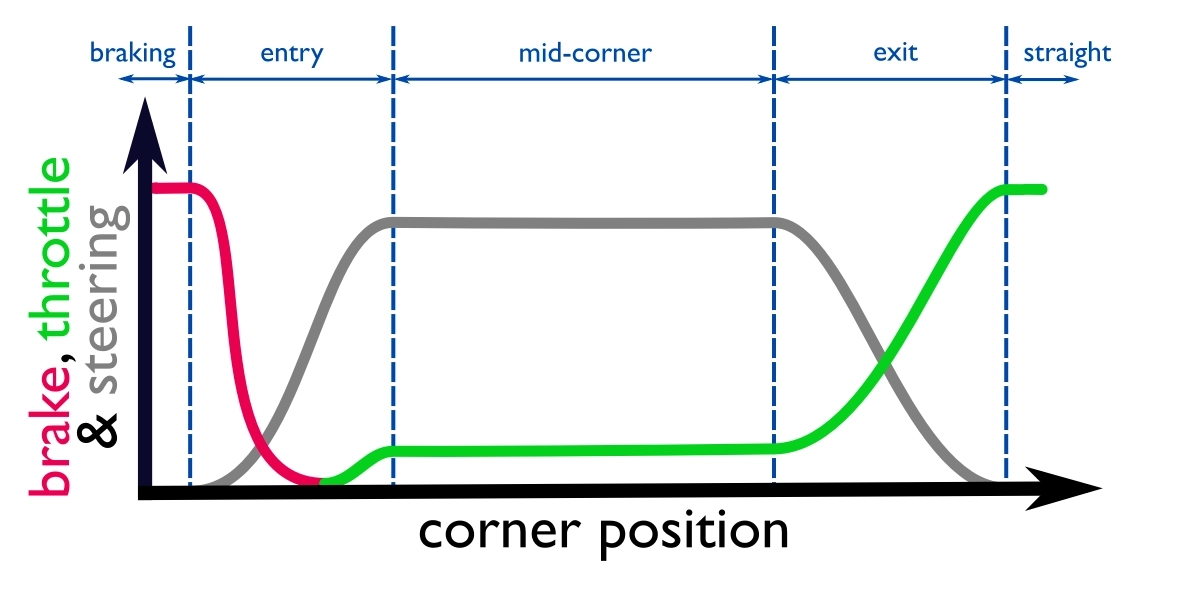
Static phases are those in which the vehicle posture and driver inputs are (relatively) constant. These phases are the braking phase, in which the vehicle is pitched forward and the driver is maximizing brake pressure; the mid-corner phase in which the vehicle is leaned over to one side and the driver is maintaining a constant steering angle and throttle position; and the straight in which the vehicle is squatted back and the driver is flooring the throttle.
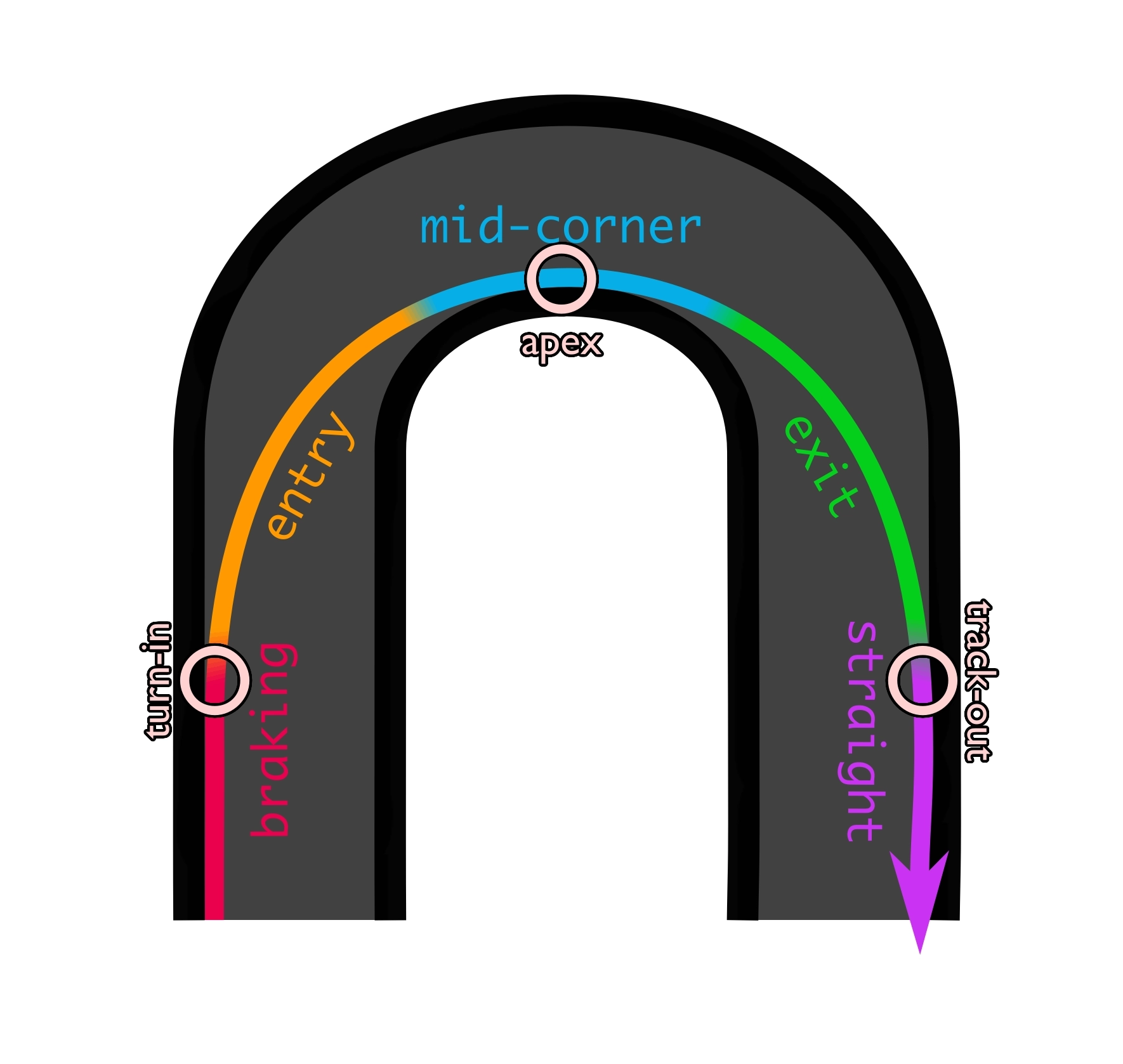
The dynamic phases are those phases between the static phases wherein the driver inputs and vehicle posture will continuously and smoothly transition from one static phase into the next. These are the entry phase, in which the vehicle transitions from being pitched forward to leaned over as the driver adds steering input and slowly comes off the brake and onto the throttle; and the exit phase in which the vehicle smoothly transitions from being leaned over to squatting back under acceleration as the driver removes their steering input and adds in the remaining throttle.
Corners are Spirals, not Arcs!
Because the dynamic phases involve continuously changing steering and pedal inputs, these phases will not create arcs of a constant radius. To the contrary, each dynamic phase forms part of a spiral, the entry phase being a segment of a spiral of decreasing radius, and the exit phase a segment of a spiral of increasing radius.
Because a driver’s goal is to always utilize all available grip, the driver will always drive along the tightest radius the vehicle can manage for its given speed. As vehicle speed increases, the arc it can maintain with its available grip will widen, and vice versa. More speed, bigger minimum radius; less speed, smaller minimum radius.
With this being the case, as the vehicle continues to slow into a corner during the entry phase, the radius the driver navigates will steadily shrink as well, and as the vehicle begins to accelerate out of the corner during the exit phase, the radius the driver navigates will steadily increase.
Navigating the 5 cornering phases involves connecting a straight, a decreasing radius spiral, an arc, an increasing radius spiral, and a final straight.
Phase Lengths Will Vary
Every corner has a unique shape, and as such, the optimal length of each of the 5 phases will vary. Long, narrow corners will require very long mid-corner phases, whereas tight, wide corners may eliminate the mid-corner altogether.
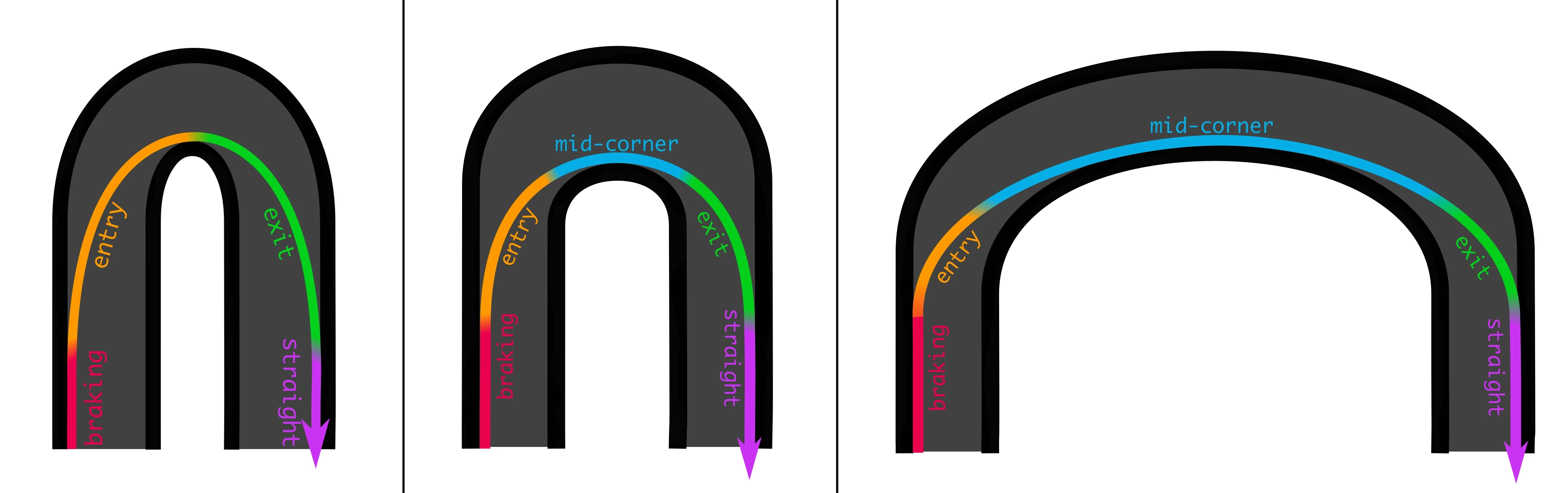
In addition to corner characteristics affecting the optimal phase lengths, so will the vehicle characteristics, although typically to a lesser extent.
The skill of driving quickly is optimizing the shapes available—straights, arcs, and spirals—to move through each corner on a track in the fastest way possible.